 The Women’s Institute for Freedom of the Press
New Kurdistan Magazine “For You”
by Cherrie Yu and Kavya Padmanabhan
Hanar Marouf, in Washington, DC for a few months, visted the WIFP office and told us about the exciting project that she has launched. Marouf describes the magazine as “the first English magazine for women in Kurdistan.” Marouf sees the need for a women’s magazine because she noticed the amount of magazines, especially in politics, that did not give a space for women to talk and express themselves. 
Marouf describes one of the projects that she undertook with For You Magazine: “We sell the magazines and all the money goes to shelters, women’s shelters; it goes to refugee camps. We recently opened a library in one of the refugee camps for women. I was visiting them and I was like, ‘What do you want, girls?’ Most of them were crying and they said all they need[ed] was to finish their education. And I said, ‘I’m not the government to provide that, but I can promise you [that] I can open a small library, so you can read books there and continuously educate yourself. So we collected the money, and we had a cooking day for fundraising, and we bought three hundred books for them. And at the camp, we opened a place for the books. They were so excited.”
The publication is mainly written by youth. But, Marouf explained, the magazine goes to female members of parliament and women in business to interview them. She explains her reasoning, “So people understand they are normal people as well, especially the members of the parliament and women in politics. People are always afraid of them. We have a stereotype. We are trying to show them, no, these are normal women! And they have family, they have children, and they are not different from us.”
On the subject of female genital mutilation, Marouf made the following comment: “I tried for every issue or every other issue to have a real story on something. We published these stories in Kurdish because we want the Kurdish society to know more about how the girls were being treated in the villages.”
You can learn more about For You Magazine by going on to the Facebook page: https://www.facebook.com/pages/For-You-Magazine/710734552276601
Shirin Neshat: Facing History
Facing History will be at the Hirshhorn Museum until September 20, 2015
By Cherrie Yu
Shirin Neshat was born in Qazvin, Iran in 1957. She lived in Iran until! 1975 when she left for the US to attend college. She did not retur! to Iran until 1990. Neshat’s works deal with a state of in between, of being on a cultural middle ground. Her photography series and her video works refer to the political upheavals in Iran that span from the 1950s to the early 2000s. Through creating art, Neshat tried to understand the experience of Iranian women during her 15 years of absence and find power in her own cultural identity.
Shirin Neshat: Facing History, curated by the Hirshhorn Museum, does not put Neshat’s works in the sequence that they were created, but in the sequence of the! Iranian! political events being referenced. The exhibition started with Munis, 2008, Neshat’s film adaptation of Shahrnush Parsipur’s novel The Women without Men. The film referred to the 1953 Iranian coup d’état, when British and American backed forces removed the democratically elected Prime Minister Mohammad Mosaddegh. Mossadegh had sought to audit the books of the Ango-Iranian Oil Company to change the company’s access to Iran’s petroleum reserves. The overthrowing of Mossadegh gave the UK and the U.S. easier access to Iran’s oil wealth. In Munis, the viewers first see Munis sitting in a room listening to the radio, eager to know about the protests on the street. Then her brother enters, brutally unplugs the radio, and tells her to get ready to meet a suitor. In the next scene, Munis jumps down from a rooftop and lies next to a! man wounded i! the protest.  Then we see Munis on the street along wit! others protesting against the imperialistic forces that ousted the democratic leader. In the end, Munis leaves the wounded protester and walks away from the empty playground. Neshat gives her female protagonist more and more power and resource as the film goes on, and the ending indicates a state of ultimate freedom from oppression and violence.
After Munis is the Women of Allah series that Neshat created after her return to Iran in 1990, upon which she felt the drastic changes the Iran had gone through in her 15 years of absence.
In 1979, Iran went through an Islamic Revolution and replaced the Shah with an authoritarian theocracy. In 1983 the government passed the compulsory veiling law demanding that women wear veils in both public and private domains. Starting in 1980, Iran and Iraq started an armed conflict that lasted until1988.
All photographs from the Women of Allah series are black and white. These women have calligraphy of Persian poetry written on their body. They are all veiled and most of them are presented with a gun. This whole series is full of conflicts: the exposed parts of a body, either the bottom of feet or a face, opposed to the hard and cold surface of the gun; the disturbed and fragile look of one woman, opposed to the expressionless of another woman holding a gun.  The poetry on the bodies of the women are written by Iranian female poets Tahereh Saafarzadeh and Forough Farrokhzad, and the theme of these texts are often exile, martyrdom and femininity. Mellisa Ho, one of the people who organized the exhibit, wrote that “far from presenting a monolithic, abiding portrait of Muslim womanhood, Women of Allah shows an artist grappling with the shifting an contradictory ideologies that have been projected on the figure of the Iranian woman, both by the government of the Islamic republic and by the west.”
Following Women of Allah are three video works. They are Turbulent, Rapture, and Fervor. Fervor commented on the prohibition in Iran against women singing in public. Neshat has two screens facing each other, one showing a male singer performing to male audiences, the other showing a veiled female singer in an empty space. Rapture also has two screens facing each other. One screen showing men running around in a fortress, the other! shows women walking on a plain. In the end a couple of women sail away and the men wave them goodbye. The theme of Rapture is more abstract, but the ending does correspond with that of Munis, where the women break free. Fervor comments on the taboo on sexual license. Unlike the last two pieces, the two screens are placed next to each other. A man and a woman encounter on a country road. Then they both go to a gathering where an authority figure preaches to a gender-segregated crow! about the harm that sex brings to the individuals and the community. In the end the woman leaves the gathering in silent protest.
The rest of the exhibit includes Neshat’s The Book of Kings Series, which is a response to the Iranian Green Movement after the 2009 Iranian election. Our House Is on Fire is a response to the aftermath of the 2011 Egyptian Revolution. The whole exhibit ends with a video piece named Soliloquy. Here Neshat focuses on her own cultural identity as an individual. She again! uses two opposing video projections in this piece, this time to call attention to her middle-ground cultural identity as an Iranian American.
Cherrie Yu is a WIFP Associate. She is a rising junior at the College of William and Mary, Williamsburg, VA.
Facing History will be at the Hirshhorn Museum until September 20, 2015.
WIFP’s Event – Beyond Conflict: Women in Palestine and Israel
Yaara Elazari and Abeer Shehadeh organized, moderated and presented at our event with the support of other WIFP folks including Martha Allen, Cherrie Yu, Kavya Padmanabhan, Riley Horan and Helena Leslie. Participants from New Story Leadership for the Middle East (http://www.newstoryleadership.org) were at the heart of the program and their photographers recorded the event.


Yaara Elazari is a 26-year-old Israeli studying Music and International Relations at the Hebrew University. Abeer Shehadeh is a 22-year-old Palestinian-Israeli who graduated from Haifa University with a degree in Literature and Political Science.
Muhannad Alkharraz is a 26-year-old Palestinian with a Fulbright Scholarship at Wisconsin University studying Policy and Economics at Freshwater Resources.

Muhannad spoke about his mothers’ personal experience living in a conflict zone. He spoke about the hope that emerges from sorrow

Chen Bareket is a 28-year-old Israeli who graduated from Hebrew University with a degree in Political Science and Sociology. He worked in both the public and third sectors. Chen spoke about the role of women in the Israeli society: obstacles and problems from a male perspective.
Sivan Atzmon is a 32-year-old graduate with honors from Tel Aviv University with a MSC in management and a Certificate in Education. She is a key founder of Victory15, a campaign for change in the 2015 Israeli elections, and she is passionate about creating social change through theatre. She spoke about the beauty model and expectations in Israel and her personal experience. 
Yaara Elazari provided a PowerPoint presentation about women in Israel and discussed women’s involvement in politics and society, with a historical perspective.


Yaara also spoke about the experience of leadership in a male-dominated organization after serving in the IDF for four years as an officer in the Liaison Department.
Abeer Shehadeh gave a PowerPoint presentation about women in politics in Palestine.


Abeer also spoke about the difficulties young Palestinian women have in Israel while attempting to obtain high educational, social and professional positions.
During the discussion section of the program, many contributed valuable responses to questions.

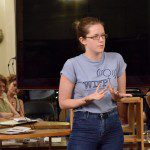
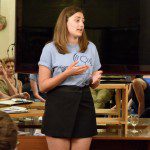
Some of the WIFP folks gathered after the event.

Invitation – “Beyond Conflict: Women in Palestine and Israel”
Join us July 17 at WIFP! The event is organized and moderated by WIFP’s Yaara Elazari and Abeer Shehadeh, with the support of Martha Allen, Kavya Padmanabhan, Cherrie Yu, Riley Horan and Helena Leslie.

WIFP Voices from Israel-Palestine
 Yaara and Abeer are currently participating in New Story Leadership program of 2015, which selects young emerging Israeli and Palestinian leaders and trains them into a team ready to help build a better future for their two communities. Ten students, five from Israel and five from Palestine, come to Washington DC every summer for an intensive program of workshops, conferences, seminars, professional work exposure, cultural immersion and team training. These two young ladies are interns in WIFP for the summer. They believe in the role of women to build a more stable and peaceful society. They also fight to be heard and to let women get the chance to express their inner voices without fear or any hesitation.
Listening to the Other Side
A Music Teacher’s perspective on the Israeli-Palestinian Conflict
Yaara Elazari, 26, is International Relations and Music Education student in the Hebrew University of Jerusalem. Yaara is a flutist at heart, music teacher and a researcher in Israel’s Ministry of Foreign Affairs.
My story begins at a Kibbutz Eilon in northern Israel. My parents had a great love for hiking. I learned from them to appreciate nature and learned to love hiking. During those hikes, I came across recorders and flutes, which were played around campfires at night. I fell in love with the sound and started a lifelong affair with learning to play this beautiful instrument. For me, music has become a new language. I found out that the music is not only a language to express myself to my surroundings, but also a language that breaks barriers between people. Music is a deeper language than words, it speaks through the heart and to the soul, and allows me to express my feelings without words.
Let me give you an example of how I used the music when I became a young music teacher, just a year ago. I would go into a classroom and teach (Israeli) children a song, but not just any song, a song in Arabic. The children’s reactions were uncomfortable, they moved in their chairs a bit. These were the first Arabic words they had ever spoken in their life. But I repeated the song, and the melodies entered their ears, challenging their old assumptions, they would say: “I don’t like Arabs, but I like this song, can we sing it again?” or “Who is this singer, can we meet her?” Using the music as a method allowed a safe ground for conversations about Palestinians, Arabs, and different cultures. I allowed the kids to respond to the music, as well as express their feelings and thoughts while singing it.
After doing this for a year, I am convinced this is something amazing and very useful. The free world of music that contains no boundaries, no state, and no separation walls, introduced me to Arab music and Palestinian musicians. It was a bridge for me, and I built that bridge for others. 
New Story Leadership brought me to Washington and allowed me to meet with Palestinians. Last week, one of the Palestinian members, Ehab, told me something that sent me back to those classrooms. He said that meeting Israelis for the first time made him feel differently about his way of thinking and generalizing, and that he feels that when he goes back to Palestine, he will prefer to refer to Israelis as individuals. Now that he knows us, we do not fit in the group he created in his mind for Israelis. I could not agree more with, and I struggle to express the strength of the hope that fills my heart when I think of the change that can be made in each one of us.
The Jewish prayer, Mishna, says “Whoever destroys a soul destroys an entire world. And whoever saves a life, saves an entire world.” We are ten members, ten different worlds, which came here with the decision to save our worlds. Save it from ignorance, save it from the stifling stereotypes that limit our minds, and build a new one together.
In order to achieve our goals for listening to the other side, we need to find the comfortable zone for each person to do so. Music is a great assistant to me, and I intend to pass it on to others.
Do you know who you are?!
Identity is regarded as one of the most pressing problems for Arab Israelis. Many writers have written poems, articles and books about it. Arab Israelis, especially women, do not find themselves belonging purely to any certain group. Their voice faded away long time ago. It did the time they were convinced that the only thing they need to care about is surviving and they have no chance of fighting to express their voices or be who they are. They were, and still are, taught to pursue careers that are not related to the Conflict or to politics at all. I can very much relate to this and the story I am telling you has led to understand how crucial the problem of identity is for us.
“My name is Abeer Shehadeh, and I come from a Christian Arab family in northern Israel. I am a graduate of the University of Haifa in politics and English Literature and I am passionate about creative writing, which is what my project for change that I am working on now as part of my participation in New Story Leadership is about.” This is how I would introduce myself if someone asked me now to tell them a little bit about myself. Who you are should be an easy question to answer. However, sometimes it is not. 
In NSL, we believe in the power of our story to change the world and I will be writing briefly about my story.
My story is a bit different from other stories for the simple fact that it does not have a certain point where it started, and it definitely did not end yet. It is not located in a specific place or related to a specific time. In other words, it seems to be the story of a lifetime.
Growing up, I never questioned my identity. I know exactly who I am, even though I believe my interests or goals might change. But I have learned that most people do not care much about who I really am. Instead, they want to define me in terms of nationality and citizenship. My parents, being tolerant and liberal, have always taught me the value of love, forgiveness, understanding and respect. I grew up being totally naïve about the situation in my country. I believed that very soon, the conflict would be resolved. I believed that Israelis and Palestinians would understand that wars and violence are never the solution. I waited for this day like a kid waiting for Santa Claus on Christmas Eve.
At nineteen, I enrolled in the University of Haifa planning to get a degree in English literature and mathematics. I wanted to distance myself from politics because I believed that Israelis would never accept me. Then I met some Jewish students and really got to know them in my classes and extracurricular activities. My attitude changed. I decided to try taking an active part in social and political clubs at my university.
Then my moment of truth came at my first club meeting, where I was asked to define myself. I told them my story and they all stared at me. Then they asked: “But, wait a second, are you a Palestinian or an Israeli?” I froze. What should I say? Why do I have to choose? I never thought I would be labeled as a Palestinian or an Israeli. I have a national Israeli Identification and passport, but my family is Palestinian. I have just realized that I am in stuck in the middle of two opposing groups. After a long pause, I stammered: “I am both.” Then they froze. After some debate, I realized that in their minds, you cannot belong to both. I do not blame them, but now I understand that I should not wait for people to accept new possibilities. That day, my quest began to make this possibility come true.
Gandhi said: “Be the change that you wish to see in the world”, and this is what I decided to do. I might not be able to influence millions of people but I could definitely start with the people around me. That was a turning point in my life. I switched from mathematics to political science and philosophy. More importantly, I believed in myself and in what people my age can do to repair broken politics. I keep asking myself is this: Do we need a nation or a country to belong to? If yes, why don’t I, and many others, have this chance? If not, then why wouldn’t we all be considered as human beings, simply citizens of the world? Can we really consider ourselves as “citizens of the world”, or is it just a term used to avoid living with the complexity of our identity?
New Story Leadership (NSL): http://www.newstoryleadership.org