 The Women’s Institute for Freedom of the Press
Soraya Chemaly receives 2016 Women and Media Award
The Women’s Institute for Freedom of the Press presented the 2016 Women and Media Award to Soraya Chemaly, a writer and activist focused on the role of gender in culture, politics, religion, and media.

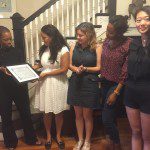
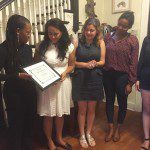
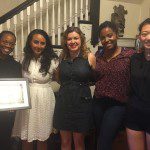
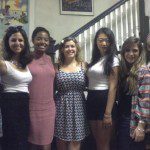
WIFP staff gathered for the ceremony June 23 and in preparation the day before. Sharing the excitement: Elana Anderson (presenting the Award), Martha Allen, Briawna Gillespie, Angelica Sisson, Lucy Lu, Batya Marcus, and Tanya Smith-Sreen.
In the summer of 2015 Soraya gave a TED talk at the Barcelona Women conference. She presented “The Credibility Gap: How Sexism Shapes Human Knowledge.” At this talk she discussed an article she wrote concerning how gender is addressed in public spaces, specifically how men’s bathrooms are larger than women’s even though women routinely need the bathroom more and for longer periods of time (due to breastfeeding, periods, etc.). She said this article, written for TIME and called, “The Everyday Sexism of Women Waiting in Public Toilet Lines” is the one for which she has received the most backlash and verbal abuse. This was shocking to her because many of her other articles contain stories of violent gender-based crimes often of a sexual nature, yet it was an article about how women deserve larger public restrooms that was the cause of public outcry.
Recently, Soraya has written about the role gender plays in the ongoing 2016 Presidential Election. At a rally in Spokane, Washington Donald Trump said Democratic Presidential Nominee Hillary Clinton is “playing the woman card.” In response, Soraya wrote the article “How Ted Cruz, Bernie Sanders, and Other Men Play the Gender Card” where she explained how men constantly bring their gender to the front of their campaigns. She said by being recognized first and foremost for their political ideals and not having to discuss their gender these candidates are themselves playing the male card.
Another powerful article Soraya published in May 2016 on The Huffington Post’s website deals specifically with the Washington D.C. Metro Area. In the article, “D.C. Metro Rape Highlights Why Women Are Always Aware of Rape,” she discusses how threats of sexual assault, harassment, and stalking are prevalent to women in the Metro area and to women who use public transit across the world. Soraya encapsulates the threats women face on public transit, writing:
We aren’t walking around petrified, saying to ourselves, “I could get raped today,” eagerly anticipating having legendary victimhood status, but by the time we are adults, at school, going to work, shopping for food, we have all been taught to adapt silently to the threat, and society’s leveraging of that threat to limit our public and civic engagement.
Through her many articles and presentations Soraya has shown time and time again that she is an eloquent speaker and a thoughtful researcher, able to pinpoint and comment on the problematic parts of gender treatment and expression in today’s society with accuracy and considerate judgment. In 2013, she won the Association for Education in Journalism and Mass Communication’s (AEJMC)’s Donna Allen Award for Feminist Advocacy and the Secular Woman Feminist Activism Award. Now Soraya has been awarded the 2016 Women and Media Award from the Women’s Institute for Freedom of the Press.
Currently, Soraya is the Director of the Women’s Media Center Speech Project and the organizer of the Safety and Free Speech Coalition. She has written for The Huffington Post, The Feminist Wire, The Guardian, TIME Magazine, The Atlantic, Rolling Stone Magazine, and other assorted newspapers and magazines. Soraya serves on the boards of multiple organizations including: Women, Action and The Media, In This Together Media, No Bully, and the Women’s Media Center.
~ by Angelica Sisson, WIFP
Invitation to join us July 1 and the program.
Join us Friday, July 1, for an evening of presentations on topics including the resurgence of self-published zines by young women; exploring women’s voices in media in Bangladesh’s garment industry; understanding rape culture; how accounts of war are gendered; women in Gaza; and lack of female representation in global politics in relation to mass media. Refreshments provided and discussion to follow.
WIFP, 1940 Calvert Street, NW, Washington, DC 20009-1502.

An exciting program! (click for a pdf version of our program)

Weaving Our Way: Personal Stories of Identity
Another WIFP booklet!
Introduction
When discussing some of our life experiences in the WIFP office one day, we got onto the topic of identity. Then and there, the four of us decided to write essays about how we each currently view our own identities to share with each other and with others interested in this topic. We talked about putting together a book- let and invited a few others on the WIFP sta to join us in this endeavor.
It was clear that there are many aspects to identity. Not all are predetermined. We may be born in a particular country, live in various countries, be raised in a speci c culture, be exposed to and in uenced by other cultures, have a gender as- signed to us at birth that ts us or not, dis
cover our sexual orientation is accepted by society or not, come from a racial line of people that have a shared history or characteristics that others respond to in various ways. Some facets we choose to give meaning to while others are automatically given to us by the world around us.
Some aspects of our identity may change over time as our life experiences impact us. We weave our di erent experiences and perspectives into many varied yet intrinsically intertwined identities.
Hearing other stories of identity can broaden and enrich our own. It can create deeper understanding of the experiences and challenges of others. We can be empowered by the stories we hear and subsequently the stories we tell. May the stories we share here serve to encourage you to speak and write about how you weave together the aspects of the identity that you hold dear.
To read this booklet:
Click here for PDF of Weaving Our Way
Presentation and Discussion on FGM
Female Genital Mutilation (FGM): New Efforts in the Campaign for Eradication
by Elana Denise Anderson, PhD
WIFP Associate Director

In a world where war has become a common occurrence with its victims hailing from every walk of life, it is easy to dismiss what some may think of as a “culturally relative” practice as less important than the wars that are deemed “necessary” by mainstream corporate media entities. The war against women’s bodies that continues to be waged mercilessly finds fodder in the form of female genital mutilation, sometimes referred to as “cutting”. While semantics often play a significant part in propagandist efforts to shift the focus away from the heinous nature of this continued practice, there is nothing that can lessen the horrific impact that it has on the bodies and psyches of women and girls upon whom it is visited.
On February 14, 2016, the Women’s Institute for the Freedom of the Press and Global Woman Peace Foundation hosted a lecture by the renowned Tobe Levin von Gleichen, CEO of UNCut/Voices Press. The primary focus of Dr. Levin’s lecture was on efforts to raise awareness of female genital mutilation through both activism and education. Her talk was both informative and engaging; it included highlights of the workshop “Contestations around FGM: Activism and the Academy” held on March 7, 2015 at the University of Oxford, as well as film clips of “The Cruel Cut”, a documentary by Leyla Hussein, herself a victim of FGM. Dr. Levin has begun a new initiative that is designed to gather experts around the topic, that it may find place in higher education with regards to research, teaching and advocacy. Publications by UNCut/Voices Press were available at the event.
Those present included Global Woman’s Amie E. Jallah and Arielle Buchmann; WIFP’s Martha Allen, Elana Anderson, Tanya Smith-Sreen and Jonathan Zeitlin; Casey Carter Swegman and Dina Baky of the Tahirih Justice Center; Stephanie Black of She’s the First (American University), and Destiny Casson of Howard University, and others. As each organization gave a brief overview of their efforts in the campaign to eradicate FGM, it became more and more evident that this is a war that can be won and must be won. The lives of future generations of women depend on it. Let us come together to stop this-NOW!
Informal discussions continued after the event:

Some of the participants gathered together afterwards for a photo:

Participating Organization Links:
UnCut/Voices Press: http://uncutvoices.com and https://uncutvoices.wordpress.com
Global Woman PEACE Foundation: http://globalwomanpeacefoundation.org
Tahirih Justice Center: http://www.tahirih.org
Women’s Institute for Freedom of the Press: https://www.wifp.org
A few other Resource Links:
Leyla Hussein’s documentary The Cruel Cut: http://leylahussein.com/the-cruel-cut/
UN: http://www.unfpa.org/female-genital-mutilation and http://www.un.org/womenwatch/daw/csw/csw52/statements_missions/Interagency_Statement_on_Eliminating_FGM.pdf
Equality Now: http://www.equalitynow.org/fgm
Talk on FGM – Dr. Tobe Levin
Women’s Institute for Freedom of the Press
and
Global Woman P.E.A.C.E. Foundation
invite you to join us for a talk and discussion
Sunday, February 14, 2016
Valentine’s Day – 3pm
Tobe Levin
Hear Dr. Tobe Levin talk about FGM – including her recent visit to WAAF (Women’s Action Against FGM – Japan) as well as efforts to create a scholars network for academic teaching about how to end FGM (in Oxford and in association with the University of Geneva). There are new books on FGM from UnCUT/VOICES Press available.
* CEO of UnCUT/VOICES Press (www.uncutvoices.wordpress.com)
* Visiting Research Fellow at the International Gender Studies Centre, Univeristy of Oxford
* Associate, The Hutchins Center for African and African American Research, Harvard University
Where: WIFP, 1940 Calvert Street, NW, Washington, DC 20009-1502
RSVP: ourmediademocracy@gmail.com